Bibliography
Four Ways of Hearing Video Game Music
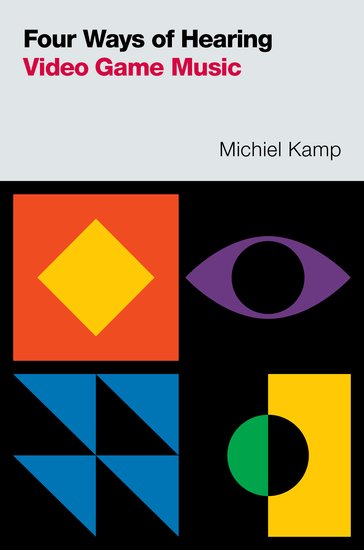
When ludomusicology was founded in the mid-2000s, scholars sought primarily to explain how and why video game music works. In his prototypical article "Play Along" (2004), Zach Whalen discusses how video game music operates as a signpost for events in the video game itself.1 In her twin monographs Game Sound (2008) and Playing with Sound (2013), Karen Collins surveys the history of sound in video games and theories for the interaction between player and game sound.2 The kinds of interpretive explanation and theorization that helped to establish ludomusicology as a viable branch of academic music studies have largely remained the principal methodological approach to the field.3
Since his early graduate work in the 2010s, Michiel Kamp has sought to expand the scope of video game music methodology. With an article in Philosophy & Technology (2014) and chapters in Music in the Role-Playing Game (2019) and The Cambridge Companion to Video Game Music (2021), Kamp has favored phenomenology as the lens through which he views video game music.4
Kamp's first monograph, Four Ways of Hearing Video Game Music (2024), stems from his research over the 2010s and early 2020s, proposing a phenomenological framework for understanding music and sound in video games. He explains his goal for the book in the introduction, stating, “I want to ask not what is significant in music in video games or why it is significant, but in what ways can video game music become significant to players.”5 To this end, Kamp traces his methodological lineage through philosophers Martin Heidegger, Edmund Husserl, and Maurice Merleau-Ponty, as well as music phenomenologists Don Ihde and Thomas Clifton. He also acknowledges the "gambit" of this methodology.6 Though phenomenology is inherently rooted in the description of personal experience, he aims for this book to be applicable to the entire field of ludomusicological and phenomenological thought. Throughout the book, Kamp often uses the pronouns "I" and "we" almost interchangeably. The conceit of Four Ways, then, is in alignment with that of phenomenology and autoethnography themselves, that one's experiences may illuminate those of others within a shared cultural context.
Central to Kamp's book are his titular four ways of hearing game music, described in each of the four chapters. The first of these chapters involves background hearing in which music does not invite attention toward itself. Kamp describes background hearing in gestaltist terms, primarily as the ground in front of or over which a game is perceived. As a game is being played, background music, if attended to, is understood as unimportant. As background, music does not necessarily register on the consciousness, but may affect mood (in the same way as Muzak's easy-listening practices) and sits among other aspects of a game that may not be foregrounded. In effect, background hearing is “a hearing that is so understanding that no explanation is necessary.”7
Background hearing stands in contrast to the following three ways of hearing: aesthetic, ludic, and semiotic. In each of these, music actively draws our attention. In aesthetic hearing, music arrests us and urges us to understand it on its own terms or in relation to the game in which it is heard. Drawing on multiple case studies in the aesthetic hearing chapter, perhaps the most evocative is that of The Elder Scrolls V: Skyrim (2011) in which Kamp describes the movement of the game's music into his attention while viewing the natural beauty of the game world.8 He relates this experience to one similar from a walk around Cambridge when the tops of buildings and the music in his earpods arrested his attention at the same time. More than background or aesthetic hearing, ludic and semiotic hearing have to do with moment-by-moment gameplay. In contrast to the arresting nature of aesthetic hearing, music does not stop the player when hearing ludically (i.e., playfully). Rather, ludic hearing invites the player to play along with the music. Described in terms of temporality, aesthetic hearing causes us to linger for a while before returning to gameplay. Ludic hearing is continuous throughout gameplay. On the other side of this temporal coin is semiotic hearing, which is significant for only a brief moment before pointing our attention elsewhere. In semiotic hearing, music acts as a signpost that communicates information about the game but does not insist on the player's continued attention.
Several passages stand out from the rest in Four Ways. Among these is a discussion found in the aesthetic hearing chapter concerning nostalgia. Referencing Marcel Proust’s madeleine episode from the first volume of In Search of Lost Time (originally published in 1913), Kamp describes moments of nostalgic hearing in video games as involuntary, serendipitous, joyous, and all-involving.9 By way of example, Kamp points to music in Super Smash Bros. Brawl (2008), which makes musical reference to previous Nintendo games, and to the “a-ha!” moments of recognizing real-world music arranged for old-timey ensembles in BioShock Infinite (2013). In the same chapter, Kamp tackles issues surrounding the Skyrim soundtrack and allegations made against its composer. In the shadow of these issues and contemporaneous problems in the gaming industry (#GamerGate, etc.), Kamp discusses that for many, the Skyrim soundtrack is impossible to hear aesthetically.10 Another standout passage arrives in the chapter on ludic hearing and concerns what Kamp calls a “gleeful diving into” of musical play in which ludic hearing enables players to engage with the game and its music in a sort of unconstrained, childlike, and whimsical state that “forget[s] our responsibilities and our place in society.”11
The most welcome additions to Kamp’s book are his supplemental video examples retrievable from the book’s companion website. These videos allow Kamp’s examples to become more tangible and do much more than simply describing his experience. While watching video of gameplay does complicate a purely phenomenological reading, it does allow the reader to understand Kamp’s experience and compare them against their own.
As the first book-length phenomenology of video game music, Four Ways of Hearing Video Game Music expands the scope of ludomusicology and seeks to name ways in which we experience game music. As experience is constantly in flux, each of the four hearing modes may apply to the same piece of music. Background music may at times enter our consciousness and encourage aesthetic, ludic, or semiotic attention. A semiotic musical cue may elicit a sense of wonder that invites us to seek out what gameplay activity caused the cue and play around with it, turning it into ludic music. Kamp’s monograph does not seek to explain why we experience game music in these ways, but to encourage an attentiveness to experience in addition to interpretation.
Four Ways of Hearing Video Game Music a very well-researched, engaging, and accessible book, and I recommend it to everyone.
Comments
No comments yet. Be the first!